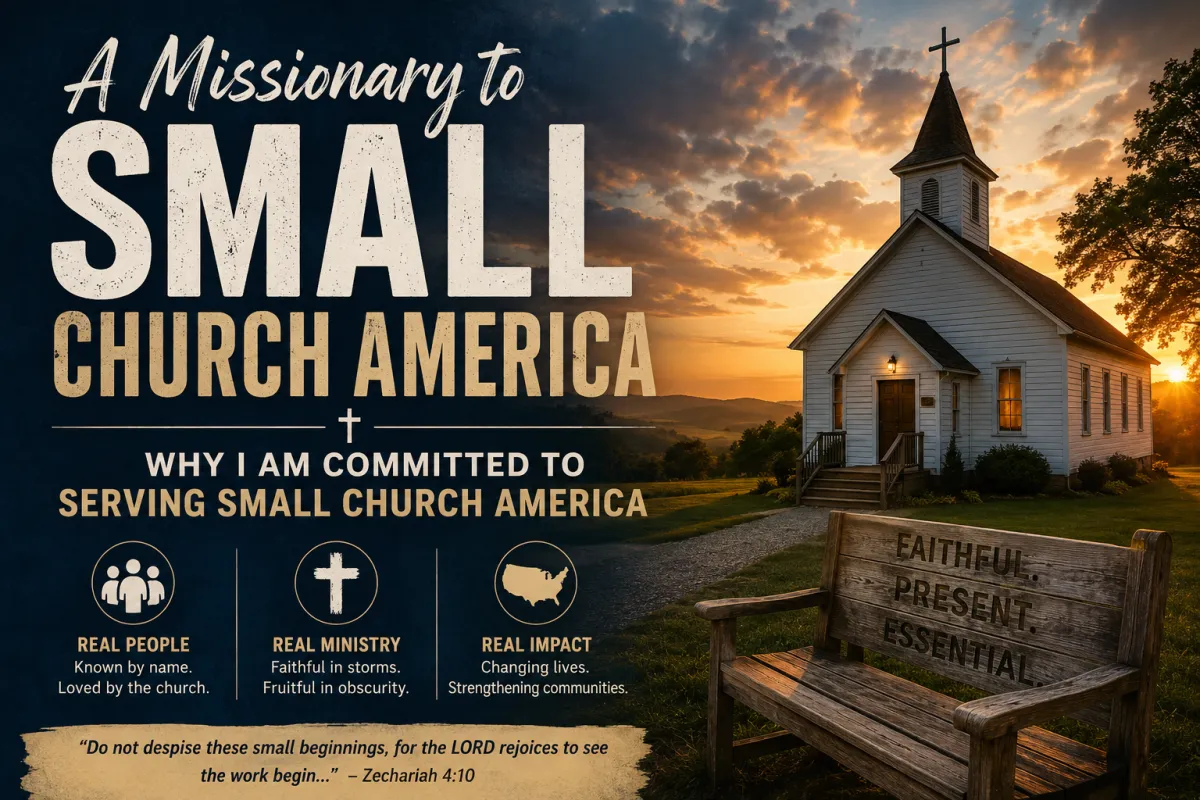
A Missionary to Small Church America
Part One: Why I Am Committed to Serving Small Church America
Over the past several years, I have found myself using a title that no organization gave me and no committee approved. It is not an official position, and it is certainly not something I use to impress anyone. It is simply the best way I know to describe the burden God has placed upon my heart.
I have come to see myself as a missionary to Small Church America.
When we hear the word missionary, we usually think about someone who travels to another nation, learns a different language, and shares the gospel with people in another culture. I deeply honor those who answer that call. The Church must continue sending missionaries throughout the world.
However, mission fields are not always located across an ocean. Sometimes they are found in small towns, rural communities, aging neighborhoods, and overlooked places throughout our own nation. Sometimes the mission field is a church that has been faithfully serving its community for generations but is struggling to understand how to move forward.
That is where my heart is drawn.
I love the small church. I love its people, its history, its personal relationships, and its potential. I love the way people in a small church know one another and notice when someone is missing. I love the way they gather around a family during a crisis, prepare meals when someone is sick, celebrate the birth of a child, support a young couple beginning their marriage, and stand beside a grieving family at a funeral.
The small church is often present during the most meaningful moments of a person’s life.
Its building may not be impressive. Its attendance may never make headlines. Its pastor may never speak at a major conference. Its budget may require careful decisions about every dollar. Still, the ministry taking place within that congregation matters deeply to the Kingdom of God.
We must stop assuming that a church is insignificant simply because it is small.
Some churches are small because they serve small communities. Others are rebuilding after a season of conflict, transition, or decline. Some are located in places where the population has changed dramatically. Others are led by pastors who work full time jobs while also carrying the responsibilities of the church.
There are many reasons a church may be small, and not all of them are signs of failure.
I believe churches should desire to reach people, make disciples, develop leaders, and grow. Numbers matter because every number represents a person whom Jesus loves. However, attendance alone cannot measure the value, health, or faithfulness of a congregation.
Some of the most important ministry in America happens in churches that rarely receive public recognition.
These churches feed hungry families, visit nursing homes, teach children the Word of God, support missionaries, help people overcome addiction, counsel struggling marriages, comfort the grieving, and proclaim the gospel week after week. They are often among the last remaining places of stability, hope, and community in the areas they serve.
I am also deeply committed to the pastors who lead these churches.
Small church pastors are some of the most dedicated and hardworking leaders I know. They preach, teach, counsel, visit hospitals, conduct funerals, plan events, manage budgets, lead volunteers, repair buildings, clean classrooms, answer late night phone calls, and carry burdens that very few people ever see.
Many of them serve without a staff. Some receive very little compensation. Others are bi vocational and work long hours outside the church before giving their evenings and weekends to ministry.
They love their people, but they sometimes feel exhausted, isolated, and overlooked.
Small church pastors often listen to leadership teaching that was created for churches with large staffs, substantial budgets, and resources they do not possess. They are told what successful ministry should look like, but they are not always shown how to lead effectively within the realities of their own setting.
They attend conferences hoping to be encouraged, but sometimes leave feeling that their church is inadequate and their ministry is failing.
I want those pastors to know they are seen.
I want them to understand that their faithfulness matters. Their preaching matters. Their prayers matter. Their presence in the community matters. The hospital visits, difficult conversations, small Bible studies, and quiet acts of service matter.
I am equally concerned about the pastor’s family.
The pastor does not serve alone. A spouse and children often experience the demands, expectations, disappointments, and sacrifices of ministry as well. They share their family member with an entire congregation. They hear criticism, feel pressure, and make sacrifices that most people never recognize.
We cannot claim to care for pastors while ignoring their families.
This is why I have chosen to focus so much of my ministry on Small Church America. It is why I write, teach, coach, mentor, and create resources for pastors and leaders. It is why I founded Strength for the Small Church. I want to offer encouragement, practical help, and a reminder that no pastor should have to lead alone.
I do not believe every small church is supposed to become a large church. I do believe every small church can become healthier, stronger, clearer, and more effective.
A small church can develop leaders. It can reach its community. It can care for its pastor and family. It can make disciples, prepare for the future, and use its resources wisely. It can honor its history without becoming trapped by it.
The small church does not need our pity. It needs our respect, encouragement, investment, and support.
I believe the small church still has a vital role in the future of Christianity in America. As long as God gives me the opportunity, I intend to stand beside its pastors, strengthen its leaders, and remind its congregations of the importance of their calling.
That is why I am committed to serving Small Church America.
That is why I have embraced the calling of a missionary to the American small church.
In Part Two, I will focus more closely on the pastor and family, the hidden burdens they carry, and what churches and Christian leaders can do to support those who serve on the front lines of Small Church America.